
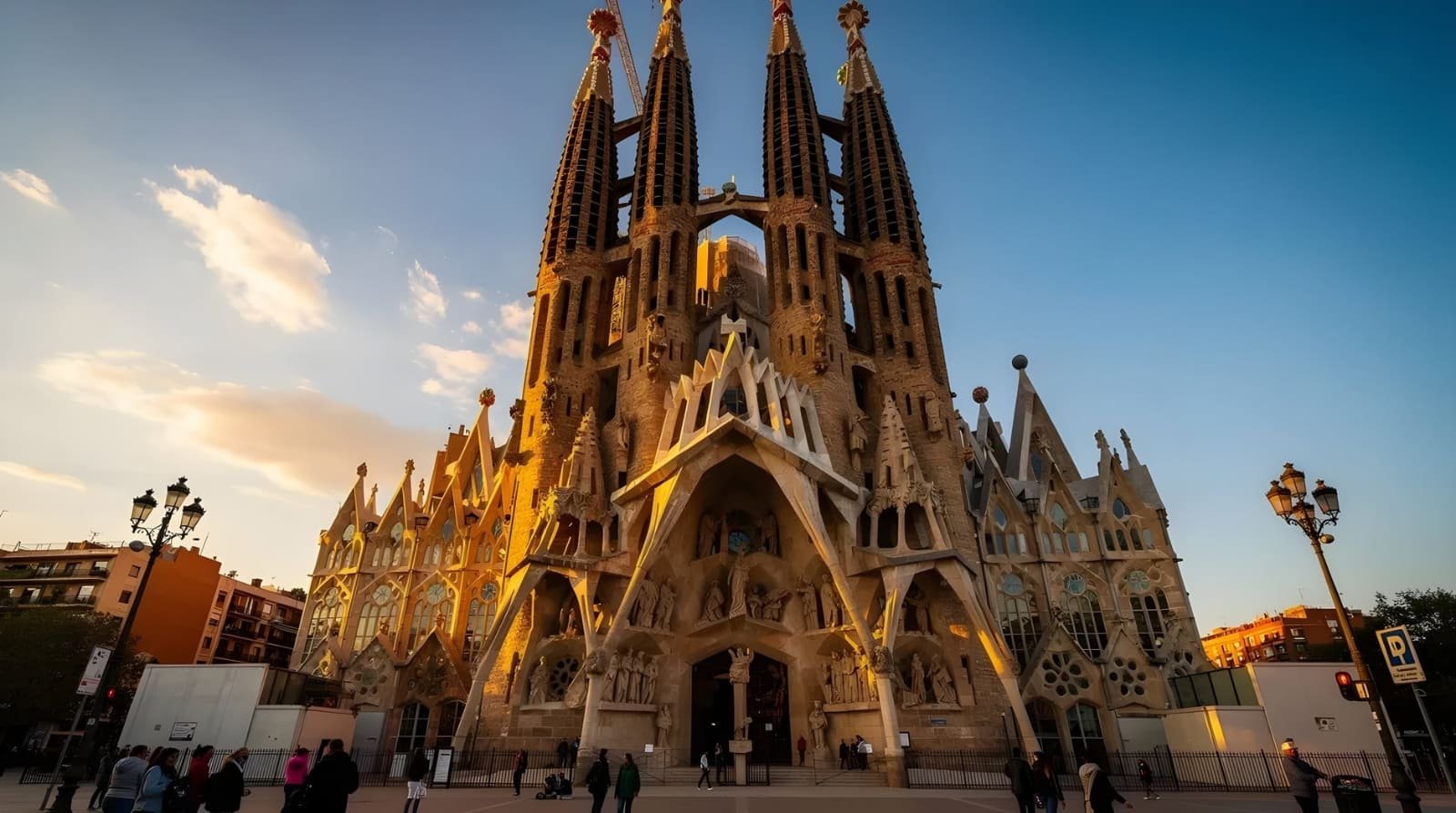
Antoni Gaudí’s Basilica of the Sagrada Família is simultaneously a place of worship, an architectural experiment and one of Europe’s most recognizable landmarks. Its exterior can appear fantastical and almost chaotic, but the interior reveals a remarkably coherent world of branching columns, filtered color and carefully controlled light.
The basilica is still an active construction site, yet this does surprisingly little to diminish the experience. For most visitors, stepping into the nave is the moment the building changes from a famous photograph into something genuinely extraordinary.

Sagrada Familia at a Glance

| Detail | Information |
|---|---|
| Location | Eixample, Barcelona, Spain |
| Architect | Antoni Gaudí |
| Construction began | 1882 |
| Recommended visit | 2–3 hours |
| Best for | Architecture, religious art and photography |
| Main highlights | Nave, stained glass, façades and museum |
| Tower access | Separate tower-inclusive ticket required |
| Accessibility | Main basilica accessible; towers are not |
| Nearest metro | Sagrada Família, Lines 2 and 5 |
| Advance booking | Essential during busy periods |
What Makes the Sagrada Familia Exceptional?

The Sagrada Família succeeds because it feels unlike any conventional European cathedral. Gaudí combined Gothic structural principles with forms inspired by trees, flowers, bones and geological formations. Almost every decorative element carries religious symbolism, yet the building never feels like a historical imitation.
Construction began in 1882, with Gaudí assuming responsibility the following year. He devoted the final decades of his life to the project, knowing that future generations would have to interpret and complete his vision.
The basilica remains unfinished. Although its rising towers increasingly define Barcelona’s skyline, work continues on major elements, including the Glory Façade and surrounding access areas. Visitors should expect cranes, barriers and occasional construction noise.
Inside the Sagrada Familia

The interior is the strongest reason to visit. Slender columns divide and branch near the ceiling like trees, creating the impression of standing beneath an enormous stone forest. The effect is expansive without feeling cold or severe.
Stained-glass windows transform the space throughout the day. Cooler blue and green light tends to dominate one side, while reds, oranges and yellows warm the opposite side. When sunlight is strong, color washes across the columns and floor in constantly changing patterns.
Despite the crowds, the nave can still produce moments of genuine stillness. Allow time to stop and look upward rather than treating the interior as a corridor between viewpoints.
The Nativity Façade

The Nativity Façade is the most intricate and emotionally warm side of the basilica. Dedicated to the birth and early life of Christ, it is covered with plants, animals, saints and biblical scenes.
It is especially important because it was the only façade largely completed during Gaudí’s lifetime. Its dense ornamentation provides the clearest surviving expression of his personal intentions for the building.
Morning generally gives this eastern façade its most flattering natural light. Even with a guided visit, spend several minutes examining it independently; many of its smaller sculptures disappear when viewed too quickly.
The Passion Façade

The Passion Façade offers a dramatic contrast. Its exposed stone, severe geometry and angular figures communicate suffering rather than celebration. Sculptor Josep Maria Subirachs deliberately avoided copying the softer forms of the Nativity side.
Some visitors find the façade unsettling, while others consider it the basilica’s most powerful exterior. Its narrative becomes much easier to follow with a guide who can explain the sequence of scenes, recurring symbols and controversial artistic choices.
The Glory Façade and Continuing Construction

The Glory Façade is intended to become the basilica’s monumental principal entrance. It represents humanity’s journey toward God, but it remains the least complete of the three façades.
The wider building is also evolving. The central towers have transformed the skyline, while finishing work and construction around other sections continue. This means the exterior may look different between visits, and some viewpoints can be temporarily obstructed.
Rather than seeing the building work purely as an inconvenience, it helps to regard the Sagrada Família as a rare opportunity to observe a monumental cathedral being completed in the modern age.
Are the Sagrada Familia Towers Worth It?

Tower access is worthwhile for architecture enthusiasts, repeat visitors and anyone interested in seeing the upper structure at close range. However, it is not essential to appreciate the basilica.
The Nativity towers overlook eastern Barcelona and provide close views of Gaudí’s richly organic façade. The Passion towers face toward central Barcelona and the coast, with a more austere architectural setting.
Visitors normally ascend by lift but descend using a narrow spiral staircase. The experience is unsuitable for wheelchair users and may be uncomfortable for anyone with limited mobility, claustrophobia or difficulty negotiating stairs. Access can also be cancelled because of weather or operational conditions.
If choosing between a guided tour and a tower upgrade, first-time visitors will usually gain more from the guide.
Is a Guided Tour Worth It?

Yes—more than at many famous landmarks. The Sagrada Família is filled with biblical narratives, numerical patterns, natural references and architectural innovations that are easy to overlook.
A strong guide explains why particular columns use different materials, how the façades communicate contrasting themes and how later architects have interpreted Gaudí’s models. The additional context turns a visually impressive building into a much richer experience.
Independent visitors should at least use the official interpretive material and include the exhibition or museum beneath the basilica.
Tickets, Security and Crowd Levels

Admission is controlled through timed tickets, and desirable sessions can sell out. Reserve in advance rather than arriving with the expectation of buying a convenient time on the day.
Standard admission generally covers the basilica and its museum or exhibition areas. Tower access must be selected as part of a compatible ticket. Review the inclusions carefully because similarly named tours may exclude the towers.
“Skip-the-line” admission avoids the regular ticket queue, but it does not bypass mandatory security screening. Travel light, as large bags and unsuitable items can complicate entry.
The interior is busiest around the main entrance, altar and strongest stained-glass viewpoints. An early session generally provides the calmest experience.
How Long Should You Spend Here?

Allow two hours for the basilica, façades and museum. A detailed guided tour or photography-focused visit can comfortably require three hours. Add approximately 30–45 minutes if your ticket includes a tower.
Walk around the entire building before leaving. Each façade presents a different visual and theological story, and viewing only the side facing Plaça de Gaudí gives an incomplete impression.
For a broader itinerary combining Gaudí landmarks, refined dining and private experiences, see LxryNow’s guide to luxury things to do in Barcelona.
Dress Code, Photography and Accessibility

The Sagrada Família remains an active Catholic basilica. Wear clothing appropriate for a religious site, with shoulders and midriff covered, and avoid very short or transparent garments. Hats should be removed inside.
Personal photography is generally permitted, but tripods, large equipment and disruptive commercial setups may be restricted. Photography rules can change during religious services.
The principal interior areas are accessible to wheelchair users, although construction and crowding can occasionally affect routes. The towers are not wheelchair accessible because visitors must descend by stairs.
Is the Sagrada Familia Worth Visiting?

Absolutely. Even travelers who feel indifferent toward churches often find the interior astonishing. Few landmarks combine architectural ambition, craftsmanship, color and evolving construction on this scale.
The weaknesses are equally clear: tickets are expensive, crowds can be intense and cranes may interrupt exterior views. Nevertheless, these inconveniences feel secondary once the nave’s columns and stained glass come into view.
The basilica deserves priority on a first visit to Barcelona and remains rewarding on a return visit because its architecture continues to change.
LxryNow Review Scorecard

| Category | Score | Assessment |
|---|---|---|
| Architecture | 10/10 | Singular in scale, structure and imagination |
| Interior | 10/10 | The defining experience of the visit |
| Exterior Detail | 10/10 | Extraordinary, especially on the Nativity Façade |
| Historical Significance | 10/10 | One of modern architecture’s defining projects |
| Visitor Experience | 8/10 | Impressive but heavily timed and crowded |
| Crowd Management | 7/10 | Organized entry, though congestion remains |
| Interpretation | 9/10 | Strong material with exceptional guided-tour value |
| Tower Experience | 8/10 | Fascinating but not essential for everyone |
| Accessibility | 8/10 | Good main-floor access; towers remain limited |
| Guided Tour Value | 9/10 | Context substantially improves the experience |
Overall Score: 9.3/10
Which Sagrada Familia Experience Should You Choose?

| Traveler | Best Choice |
|---|---|
| First-time visitor | Guided basilica tour |
| Architecture enthusiast | Guided tour with museum and tower option |
| Couple seeking flexibility | Private guided tour |
| Limited time | Timed-entry or short guided visit |
| Gaudí-focused traveler | Sagrada Família and Park Güell combination |
| Reduced mobility | Main basilica ticket without towers |
Book the Experience

Compare Sagrada Família tickets and tower options
Best for comparing available entry formats before choosing.

Sagrada Família skip-the-line guided tour
A practical first-visit option with architectural and historical context.

Private skip-the-line Sagrada Família tour
Ideal for couples, families or travelers wanting a more personal pace.

Private guided tour with museum visit
Suited to visitors interested in the building’s models, design and construction history.
Check each experience’s current inclusions before booking, particularly tower access, language and meeting-point details.
Pros and Cons
| Pros | Cons |
|---|---|
| One of the world’s most distinctive interiors | Heavy crowds throughout much of the year |
| Exceptional stained glass and natural light | Premium admission costs |
| Rich architectural and religious symbolism | Ongoing construction affects some views |
| Strong guided-tour value | Tower descent is physically restrictive |
| Convenient metro access | Advance planning is essential |
| Continues to evolve between visits | Security and timed entry reduce spontaneity |
Final Verdict

LxryNow Verdict: The Basilica of the Sagrada Família is not merely Barcelona’s most famous building—it is the city’s defining cultural experience. Its construction can complicate the exterior visit, but the luminous nave, symbolic façades and audacious engineering justify the crowds and advance planning.
Book a guided visit, arrive with enough time to circle the entire basilica and treat tower access as an optional enhancement rather than the main event.
Overall Score: 9.3/10
