
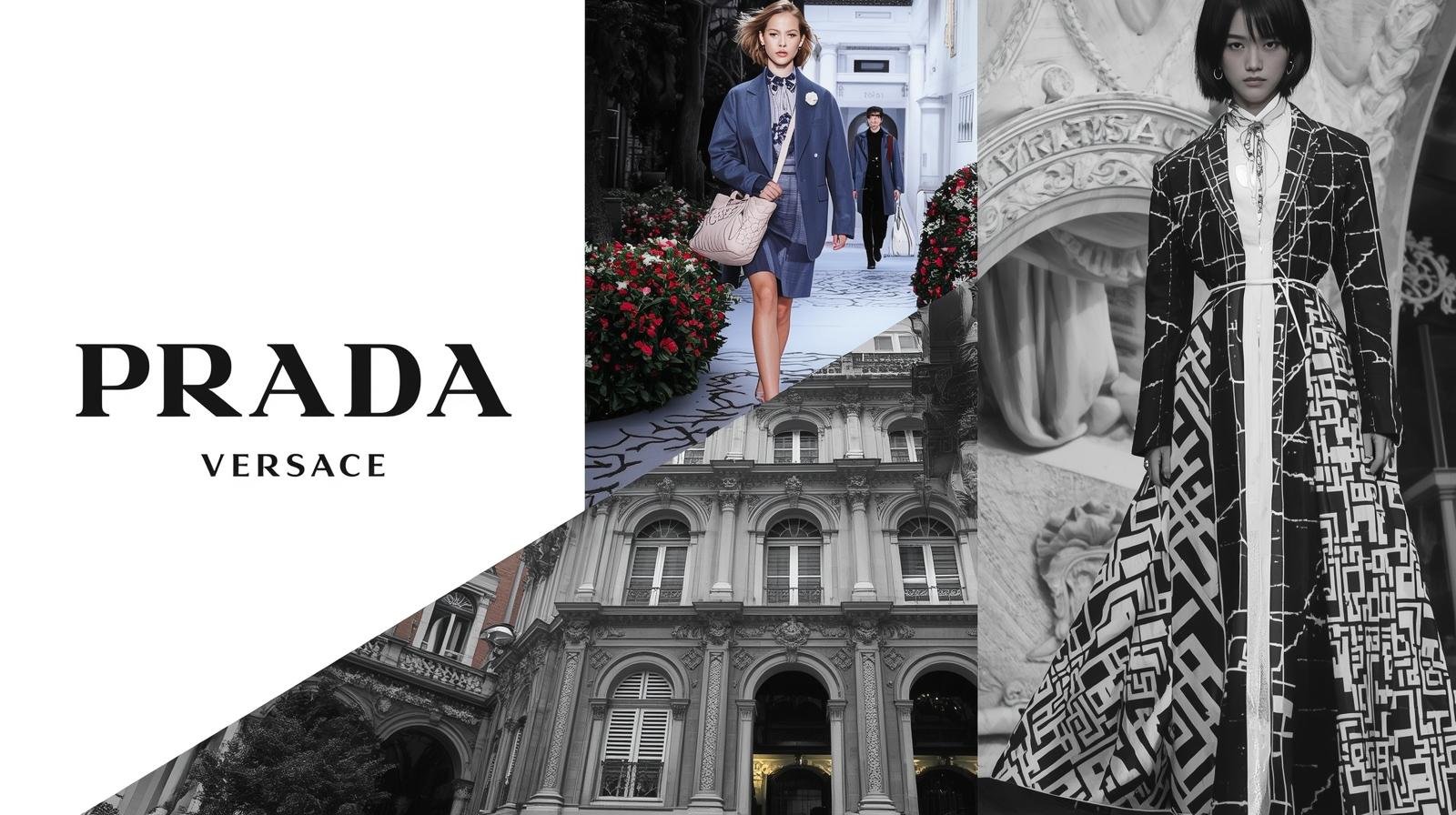
TL;DR
The Prada–Versace deal is finalized, creating a powerful new alliance within Italian luxury. Vogue reports that both houses will maintain creative independence while sharing infrastructure and strategy—positioning Italy to better compete with global luxury giants. The partnership strengthens both brands and may signal the start of a broader consolidation movement in Milan.
At a Glance
- The Prada–Versace deal is officially finalized, marking one of the most significant business moves in contemporary Italian fashion.
- The agreement consolidates two of Italy’s most influential luxury houses under a coordinated strategic structure.
- According to Vogue, the deal aims to strengthen brand autonomy while maximizing shared resources, including manufacturing, distribution, and global expansion potential.
- The move signals a shift toward Italian megagroups, positioned to compete with LVMH, Kering, and Richemont on a global scale.
- Creative leadership remains a focal point, with questions surrounding brand identity, potential crossovers, and the evolution of each house’s aesthetic.
Inside the Prada–Versace Deal: What We Know
According to Vogue’s reporting, the partnership is designed to protect creative independence while unlocking joint operational advantages. That means:
1. Shared Infrastructure, Separate Identities
Both houses retain their brand DNA—Prada’s minimalism and Versace’s maximalism—but can now tap into shared manufacturing networks, supply-chain efficiencies, and global distribution power.
2. Stronger Position Against Global Luxury Giants
LVMH and Kering have dominated through scale. This deal marks Italy’s strongest attempt yet to form a homegrown fashion powerhouse capable of competing at the same level.
3. Reinforced Leadership
Miuccia Prada, Patrizio Bertelli, Donatella Versace, and Capri Holdings leadership remain central. The deal signals trust in existing creative and executive direction rather than a restructuring takeover.
4. Potential for Shared Innovation
With aligned resources, both brands could advance in:
- Sustainable materials
- Digital retail expansion
- AI-driven personalization
- Next-gen craftsmanship
Italy’s luxury innovation pipeline just became a lot more powerful.
What This Means for Prada
For Prada, the deal accelerates its momentum. The brand has enjoyed a multiyear resurgence thanks to strong ready-to-wear growth, Miuccia Prada and Raf Simons’ creative partnership, and powerful accessories demand.
The new alliance gives Prada:
- Larger global reach
- Improved supply chain security
- Greater investment capacity
- Ability to push innovation even faster
Expect Prada to double down on its position as the intellectual, architecturally sharp leader of Italian fashion.
What This Means for Versace
Versace enters this deal with strong brand heat—particularly among Gen Z and celebrity culture—but less structural stability than Prada.
The partnership offers Versace:
- Stronger financial backing
- Better long-term supply-chain infrastructure
- Greater operational flexibility
- Stability for strategic brand evolution
Versace can continue being bold, glamorous, and maximalist, but now with the manufacturing and distribution muscle to scale sustainably.
The Future of Italian Luxury: Consolidation & Competition
This deal signals a turning point in Italian luxury. After decades of independence, major houses are recognizing that global luxury competition requires:
- Bigger groups
- Shared logistics
- Unified investment power
- Tech-focused innovation
- Rapid, global-scale decision-making
With Prada and Versace forming a new Italian luxury axis, other houses may be pushed toward mergers or strategic alliances.
Italy’s next fashion chapter may be defined not by individual houses, but by the Italian Luxury Supergroup Era.
Editorial Perspective
This deal doesn’t mark the merger of two brands—it marks the merger of two empires. Italy has long celebrated its independent houses: family-led, creatively distinct, culturally rich. But the modern luxury landscape rewards scale, data, global logistics, and unified megastructure strategies.
The Prada–Versace alliance signals a new reality: to compete with Paris and Geneva, Milan must consolidate power.
What’s fascinating is the balance: both brands are iconic, both are culturally influential, and both have strong creative leadership. Yet they must now coexist in a shared ecosystem. How they maintain individuality while leveraging collective strength will define the future of Italian luxury.
