
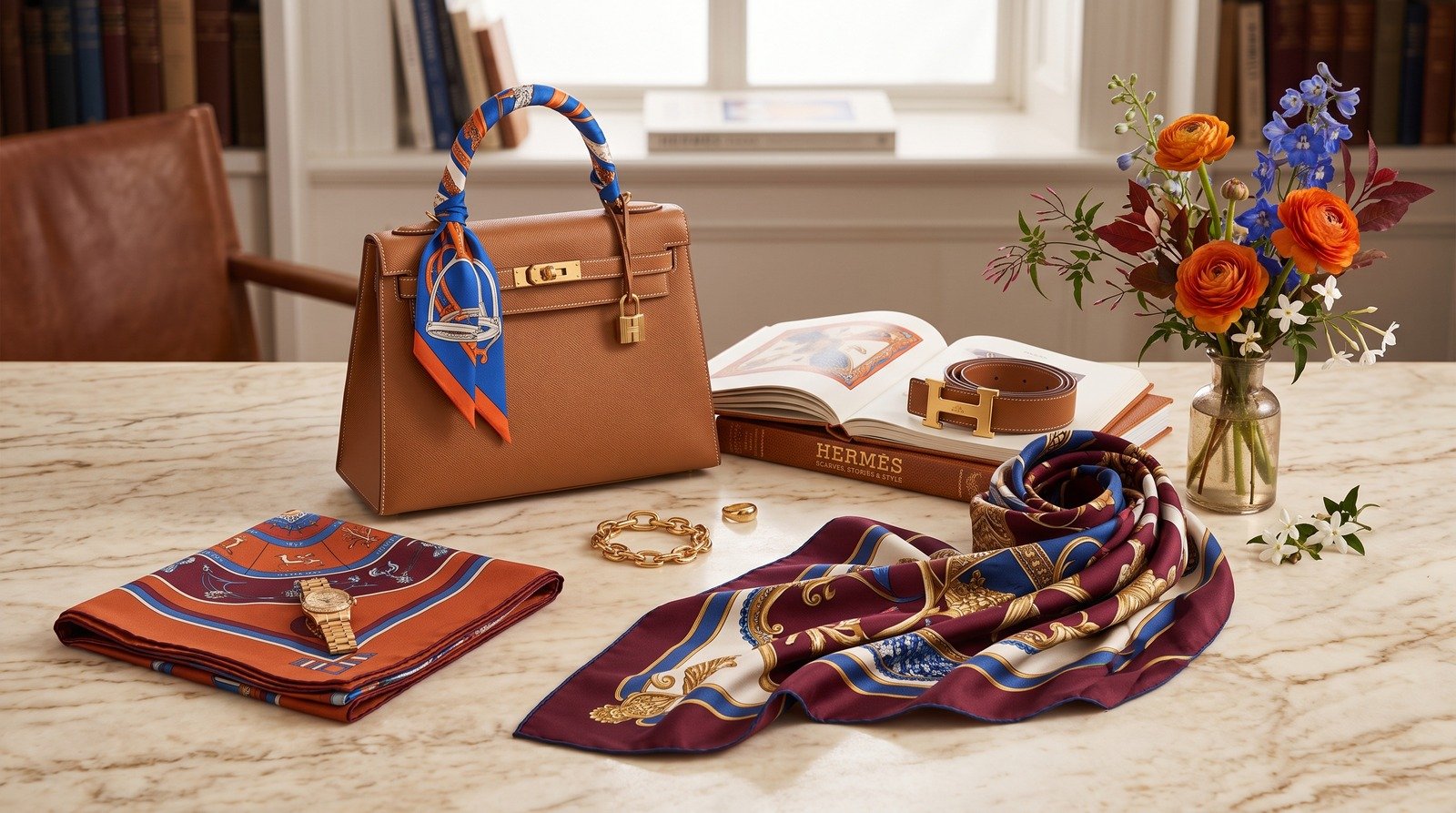
A first Hermès scarf can feel surprisingly difficult to choose. The square may appear straightforward, but the house offers numerous formats, fabrics, colours and designs—each of which behaves differently once folded or tied.
The most famous option is the silk Carré 90, a square measuring approximately 90 centimetres. It is large enough to showcase the artwork, yet manageable enough to wear around the neck, over the hair, at the waist or as a top. That versatility makes it the strongest first choice for most buyers.
A Twilly may be easier and less expensive, while a Carré 70 feels lighter and more casual. The cashmere-and-silk 140 shawl provides warmth and greater visual impact, but it requires a larger investment and can be more fabric than a first-time wearer needs.
The right decision depends on how the scarf will actually be worn. Format should come first, followed by colour, design and material. A beautiful scarf that coordinates with clothing already in your wardrobe will provide far more value than the rarest print left permanently inside its orange box.

TL;DR
- The Carré 90 is the strongest first Hermès scarf for most buyers.
- Choose the format before becoming attached to a particular print.
- A Twilly is best for small neck knots, hair styling, wrists and bag handles.
- The Carré 70 feels lighter and less formal than the classic 90.
- A 140 cashmere-and-silk shawl provides warmth and dramatic drape.
- Look at the scarf’s corners and borders because these remain visible after folding.
- Select colours that repeat at least two or three shades already present in your wardrobe.
- Medium-contrast designs are usually easier to style than very pale or highly saturated prints.
- Begin with simple folds rather than attempting complicated knots immediately.
- Keep perfume, rain, makeup and jewellery away from the silk.
- Store the scarf flat, dry and untied when it is not being worn.
Why the Carré Became an Hermès Signature
Hermès introduced its first silk scarf in 1937. Named Jeu des omnibus et dames blanches, it was created under Robert Dumas, the son-in-law of Émile Hermès. (Hermès History)
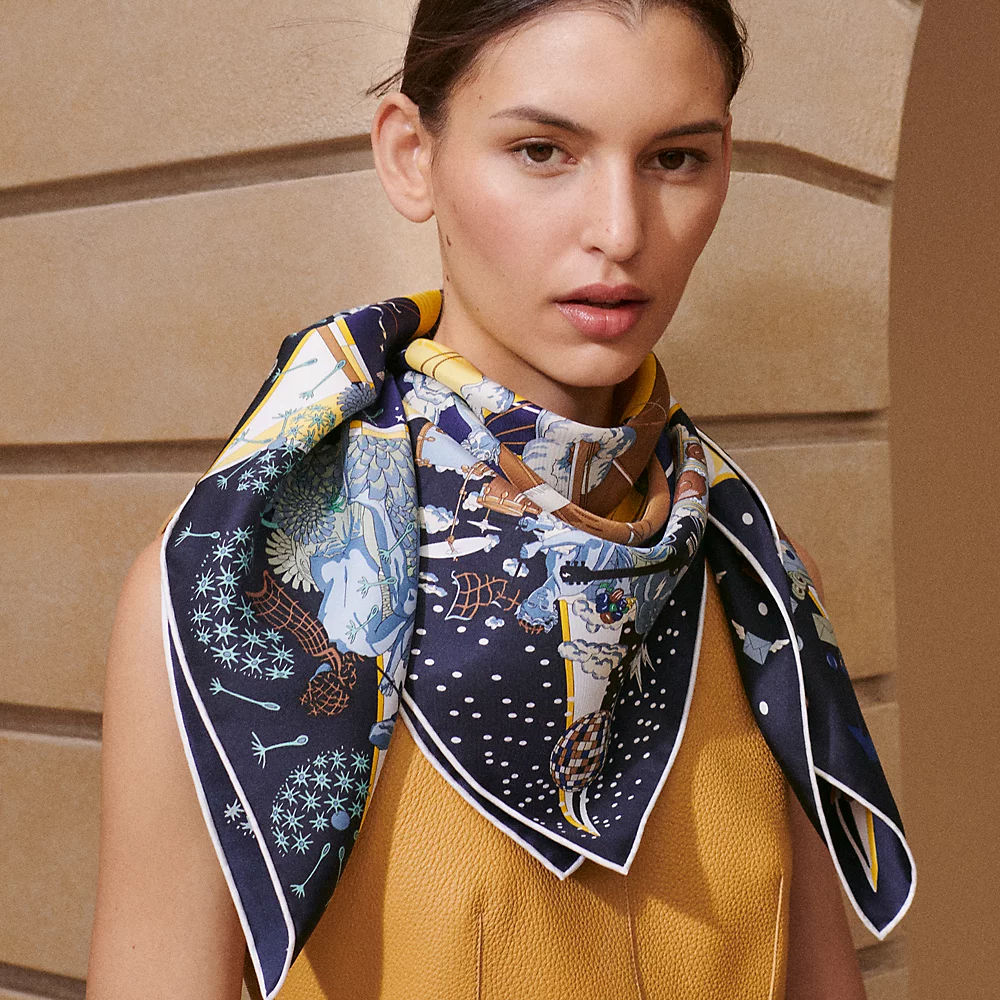
The square format gave illustrators a generous canvas, allowing the scarf to combine fashion with narrative art. Equestrian equipment, architecture, mythology, nature, travel and playful fantasy have all appeared within its borders.
The house’s saddlery origins remain particularly visible. Harnesses, bridles, stirrups, horses and carriages frequently appear either as central subjects or abstract decorative elements. The iconic Brides de Gala design, introduced in 1957, was inspired by an exceptional harness from Émile Hermès’ personal collection and has since been reinterpreted in around 30 versions. (Hermès Brides de Gala)
Traditional silk scarves are printed using a flatbed process associated with the Lyon silk-making region. Individual colours combine to produce the depth and precision for which Hermès designs are known, while hand-rolled edges give the finished square its distinctive raised border. (Hermès Silk Printing)
These details matter, but they should not make the scarf feel untouchable. The Carré was designed to be folded, knotted and incorporated into daily clothing.
Choose the Format Before the Design
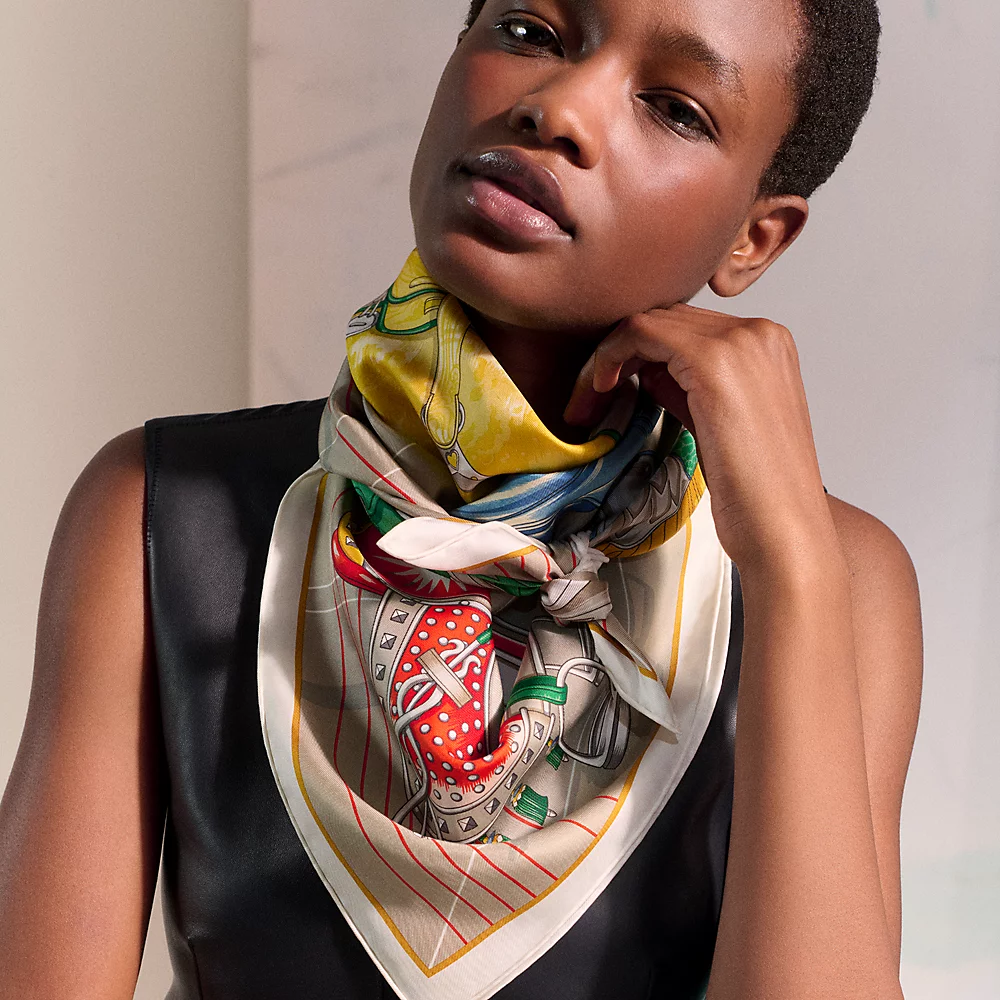
Hermès scarves are available in formats ranging from narrow ribbons to large squares. The dimensions determine how much material must be managed and which styling methods work comfortably.
| Format | Approximate Size | Best Uses | First-Purchase Consideration |
|---|---|---|---|
| Twilly | 5 × 86 cm | Neck, wrist, hair or bag handle | Easy to use but does not display a full square design |
| Carré 45 | 45 × 45 cm | Small neck knot, hair or bag | Compact and casual, with limited drape |
| Bandana 55 | 55 × 55 cm | Neck, hair and casual outfits | Sportier than the traditional Carré |
| Carré 70 | 70 × 70 cm | Neck, head or relaxed triangular knot | Lighter and easier to manage than a 90 |
| Carré 90 | 90 × 90 cm | Neck, shoulders, hair, waist or top | Best all-round first Hermès scarf |
| Scarf 100 | 100 × 100 cm | Generous neck wrap or shoulder styling | Often available in cashmere and silk |
| Shawl 140 | 140 × 140 cm | Shoulders, outerwear and cold-weather wrapping | Luxurious and versatile but more expensive |
The Carré 90 measures approximately 34.8 inches square, although slight variation is expected because the edges are rolled by hand. Current examples are made in France from 100% silk twill. (Les Chevaux Déchaînés Scarf 90)
Choose a Twilly if you mainly want to decorate a bag, ponytail or shirt collar. Select a Carré 70 if you prefer smaller knots and less fabric near the face. Consider the 140 shawl when warmth and coverage matter more than compact styling.
If you are uncertain, begin with the Carré 90. It offers enough fabric to experiment without becoming as overwhelming as the largest formats.
Select Colours From Your Existing Wardrobe
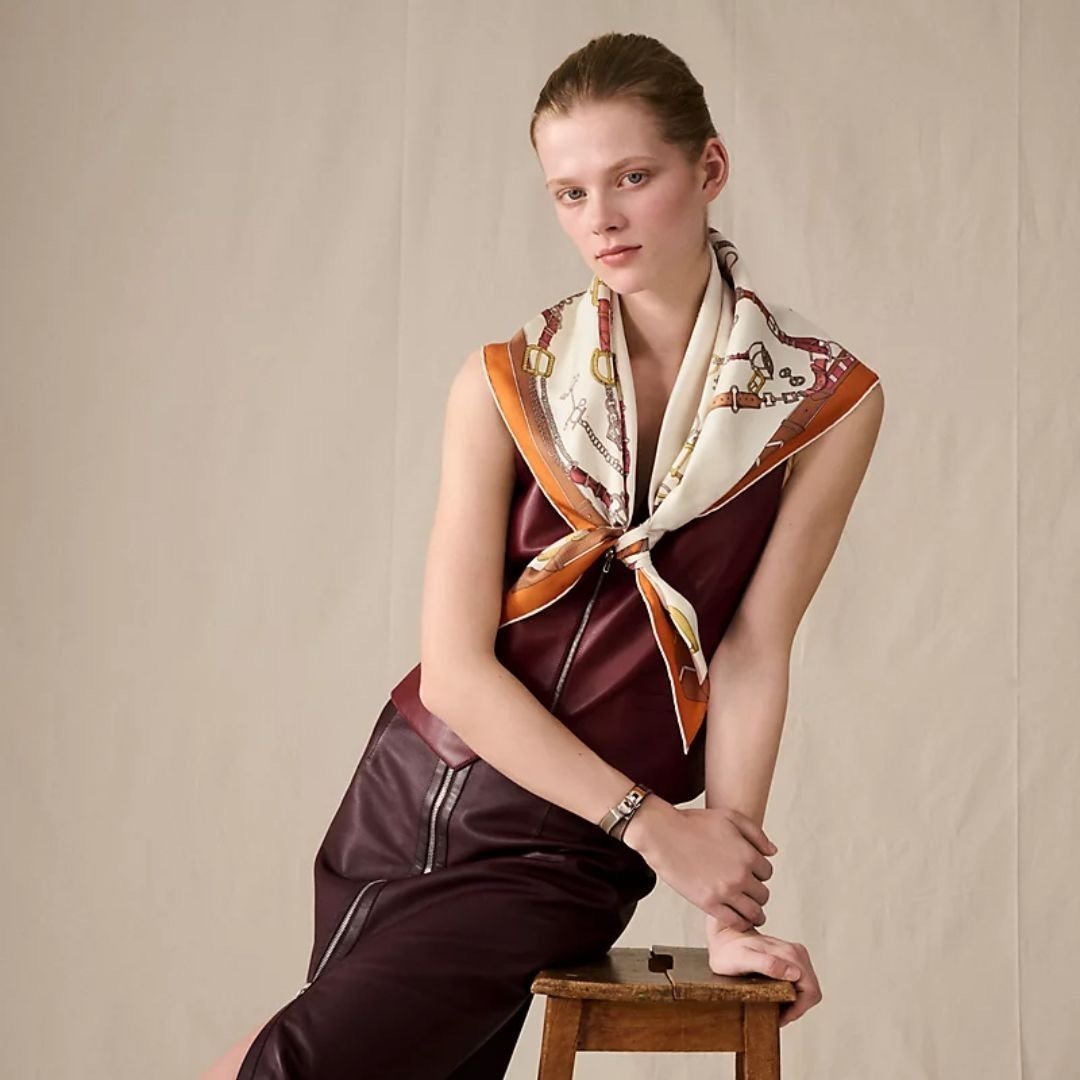
A scarf can contain many colours, but not every shade has equal importance once it is folded.
The central illustration may dominate when the scarf is displayed flat, while the borders, corners and diagonal sections become more visible when worn. Examine the entire square rather than judging it only by the central motif.
Before buying, identify three elements:
- The border colour: This often frames the final knot and can determine whether the scarf feels light, dark or highly contrasted.
- The dominant field: This controls the overall impression when the scarf is worn over the shoulders or as a top.
- The accent colours: These provide small connections to shirts, knitwear, lipstick, bags or jewellery.
A practical first scarf should include at least two shades already found in your wardrobe. If you often wear navy, cream, camel and denim, a scarf combining blue with warm beige and a small amount of orange will be easier to use than one based entirely around neon pink and lime.
| Wardrobe Palette | Scarf Colours to Consider |
|---|---|
| Black, white and grey | Red, cobalt, emerald or monochrome graphics |
| Navy, denim and white | Blue, cream, gold and restrained orange |
| Camel, brown and ivory | Burgundy, forest green, caramel and soft pink |
| Olive and earth tones | Rust, ochre, petrol blue and natural beige |
| Pastels and light neutrals | Rose, pale blue, lilac and soft yellow |
| Brightly coloured wardrobe | Black-bordered or neutral-ground designs |
Very pale scarves can be elegant but may lose definition against light clothing. Highly saturated designs create more impact but can be harder to repeat. A medium-contrast colourway usually provides the safest balance.
Decide Whether You Want Heritage or Contemporary Artwork
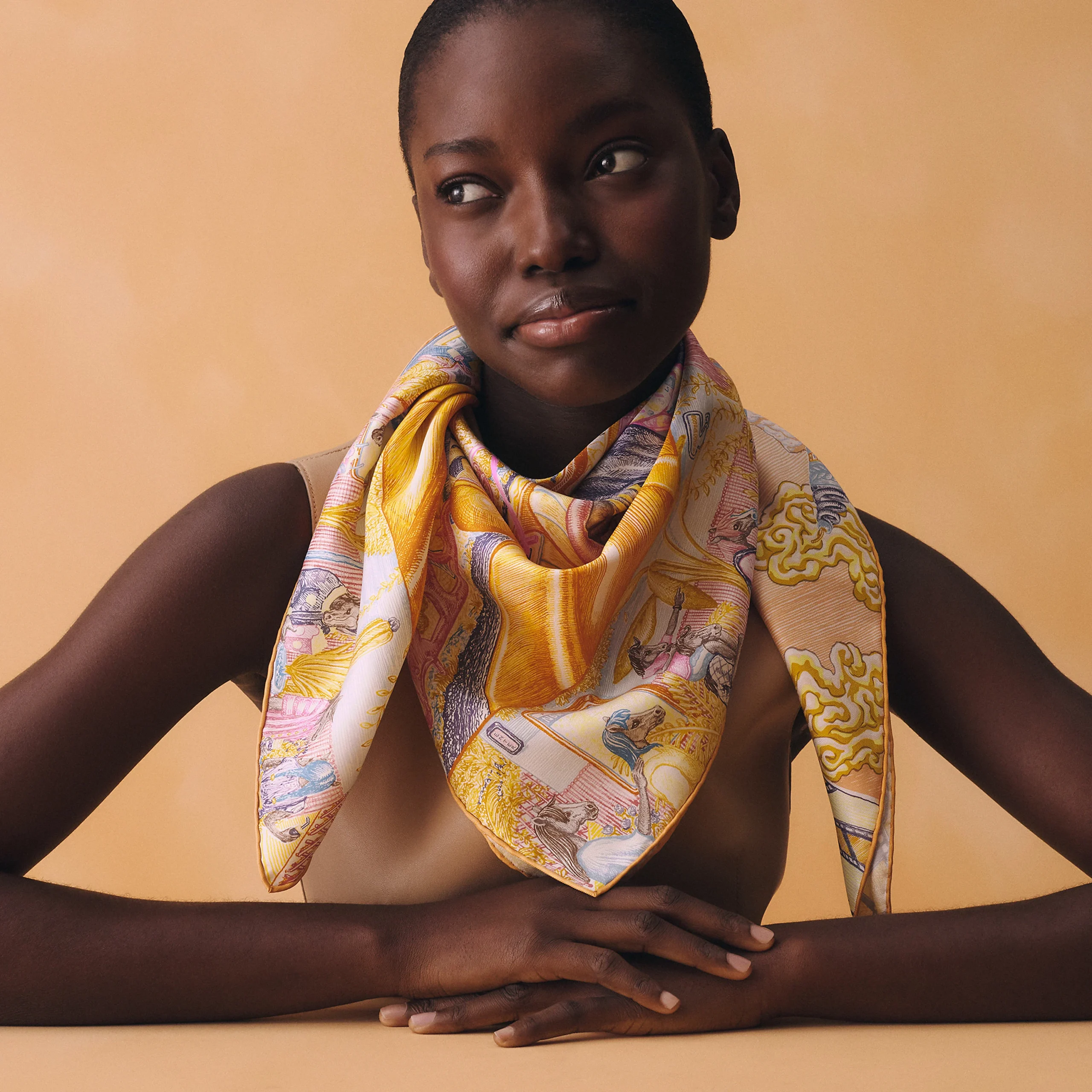
Hermès continually reissues heritage designs while commissioning contemporary artists to create new interpretations.
Traditional scarves often feature symmetrical arrangements of saddles, bridles, carriages, chains or ceremonial objects. These designs communicate the house’s history clearly and can feel formal when tied neatly around the neck.
Contemporary designs may include graphic lettering, surreal landscapes, comic-book references, abstract geometry or playful animals. They can feel younger and may integrate more naturally with denim, oversized shirts and relaxed tailoring.
Neither direction is automatically more timeless. Longevity depends on whether the artwork continues to feel personal to the wearer.
When comparing designs, ask:
- Do I enjoy the artwork even when it is displayed flat?
- Which parts remain visible after a diagonal fold?
- Does the border coordinate with my coats and jackets?
- Is the subject meaningful to me, or am I choosing it only because it is recognisable?
- Would I still wear these colours if the design were not from Hermès?
- Does it feel too formal or too playful for my usual clothing?
A first scarf does not need to be the most famous design. Personal relevance will encourage more frequent use.
Silk Twill or Cashmere and Silk?
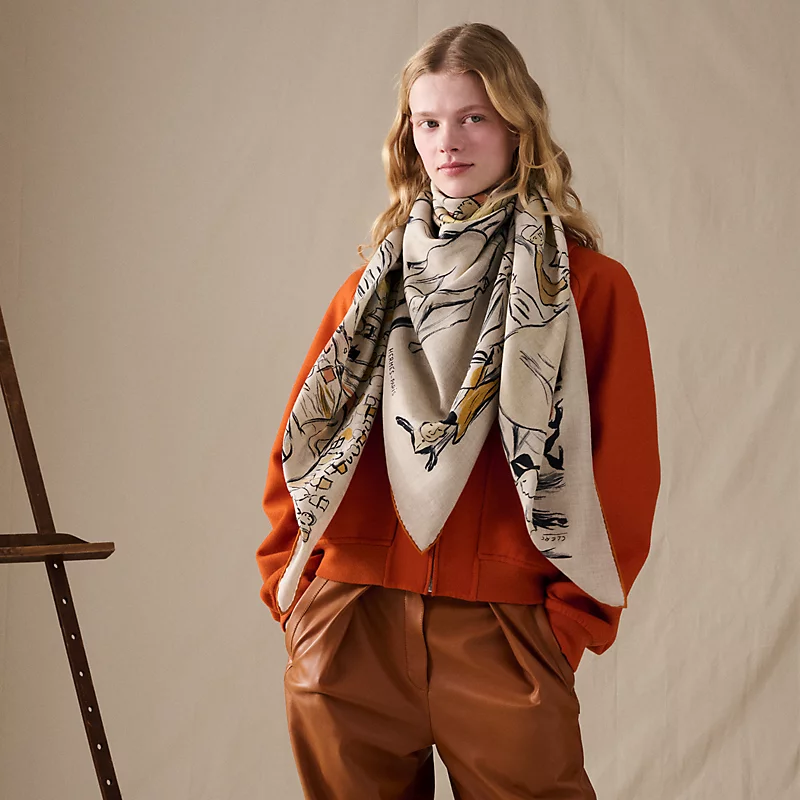
The classic Carré is made from silk twill. It has enough body to hold a knot and enough fluidity to drape attractively. New silk can feel relatively crisp, but repeated careful wear generally allows it to become softer.
Cashmere-and-silk shawls behave differently. Hermès commonly uses a blend of 70% cashmere and 30% silk for its 140 format. The result feels warm, soft and lightweight relative to its size.
| Material | Advantages | Limitations |
|---|---|---|
| Silk twill | Holds folds well, displays colour clearly and works year-round | Vulnerable to water marks, pulls and perfume |
| Vintage-wash silk | Softer and more relaxed from the beginning | Less crisp for sculptural knots |
| Double-face silk | Different printing on both sides increases styling possibilities | Costs more than a standard silk square |
| Cashmere and silk | Warm, light and suitable as a shawl | More vulnerable to friction, pilling and moths |
| Pleated silk | Creates texture and compact volume | More specialised and harder to restyle flat |
For a first purchase, silk twill is the most logical choice. It displays Hermès artwork clearly and supports a wider range of knots.
Choose cashmere and silk if you primarily want an alternative to a light jacket, travel wrap or winter scarf rather than a small decorative accessory.
Five Easy Ways to Style Your First Hermès Scarf

Complicated knots are not required. A simple fold usually looks more natural and places less stress on the silk.
1. The Relaxed Triangle
Fold the square diagonally into a triangle. Place the centre at the front of the neck, cross the ends behind and bring them forward. Leave them loose or tie a small knot.
This method works with shirts, crewneck sweaters and open jackets. It also displays the border and one corner of the design.
2. The Bias-Fold Neck Tie
Fold opposite corners toward the centre, then repeat until the scarf forms a long band. Wrap it once around the neck and tie the ends slightly off-centre.
The bias fold produces a cleaner, narrower shape. Wear it under a collared shirt, over a T-shirt or with an unstructured blazer.
3. The Simple Headscarf
Fold the Carré 90 diagonally. Place the folded edge near the hairline and tie the ends beneath the hair or at the back of the neck.
Use a comfortable knot and avoid securing the silk with rough clips. A scarf with a strong border creates the clearest visual frame.
4. The Shoulder Drape
Place a 90 or 140 scarf around the shoulders and allow the ends to fall naturally. Secure it with a loose front knot or scarf ring if necessary.
This is particularly effective over a plain dress, fine knit or evening top because the scarf supplies most of the colour.
5. The Waist Accent
Bias-fold a 90 into a band and thread it through belt loops or tie it over a simple dress.
Avoid pulling the silk tightly against sharp zippers, metal loops or textured denim. The method works best with smooth trousers, skirts and dresses.
Hermès also provides official demonstrations for several Carré 90 knots. (How to Tie Your Hermès Scarf)
How to Use a Twilly Without Limiting It to a Bag
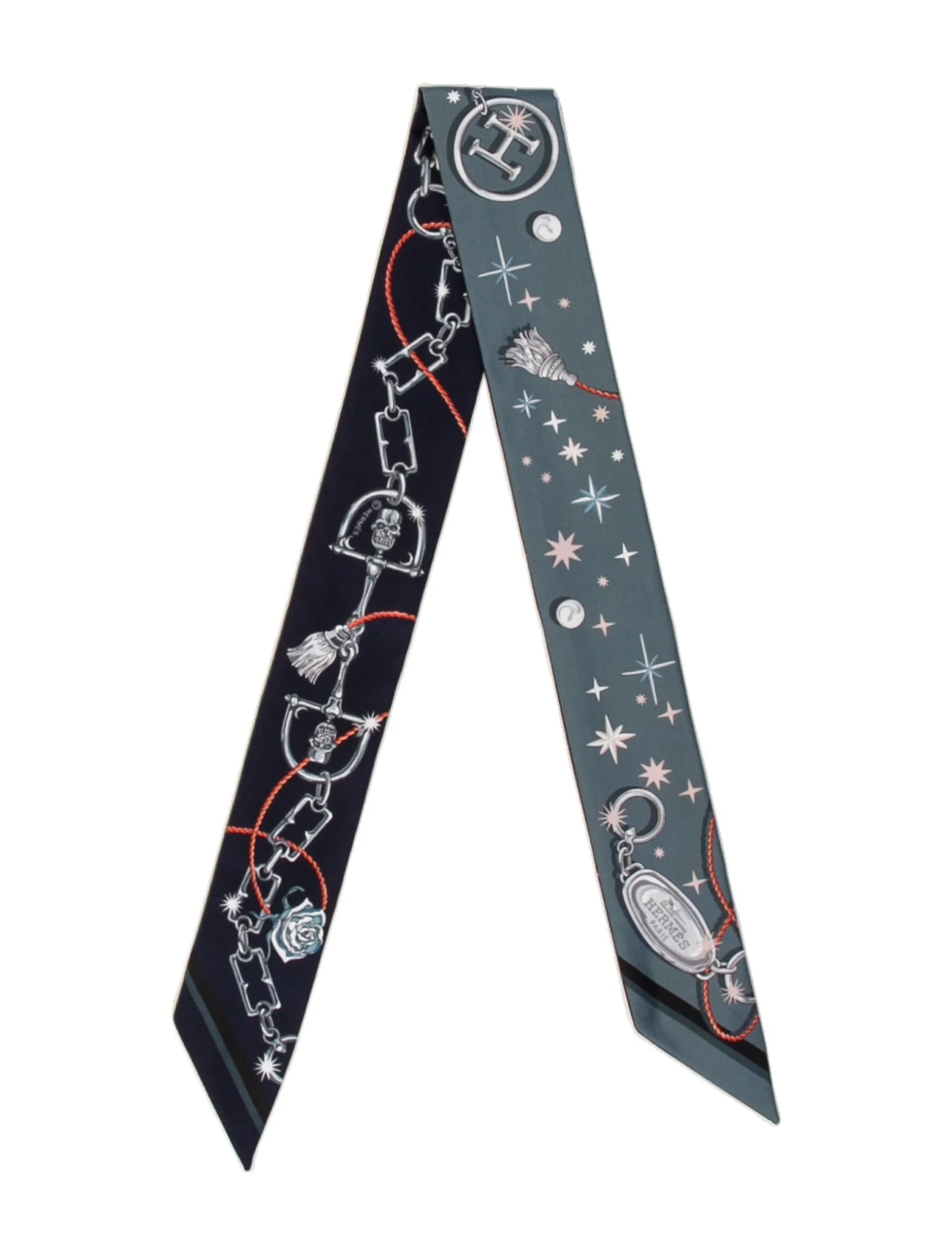
The Twilly is commonly wrapped around bag handles, but it has several other uses:
- Tie it once around the neck with short ends.
- Wrap it around a low ponytail or bun.
- Use it as a soft headband.
- Tie it around the wrist in place of a bracelet.
- Thread it through a scarf ring.
- Wrap it around the base of a hat.
- Wear it as a narrow belt over a light dress.
At approximately two inches wide and 34 inches long, it creates a controlled accent rather than a large area of print. Current standard Twilly designs are made in France from 100% silk and are listed at $260 in the US. (C’est la Fête Twilly)
A Twilly is a good first Hermès silk purchase when the wearer prefers small accessories. It is not the best introduction for someone who wants to experience the artistry and versatility of a full carré.
How to Style the Scarf With Everyday Clothing

The scarf is easiest to style when the surrounding outfit contains one of its colours.
| Occasion | Styling Formula |
|---|---|
| Weekend | White T-shirt + straight denim + scarf in a relaxed triangle |
| Office | Neutral blazer + silk shirt + small bias-fold neck knot |
| Travel | Fine knit + relaxed trousers + Carré 90 over the shoulders |
| Evening | Black dress + scarf draped asymmetrically |
| Resort | Linen shirt + wide trousers + scarf worn over the hair |
| Cold weather | Wool coat + knitwear + cashmere-and-silk 140 shawl |
| Minimal wardrobe | Monochrome outfit + brightly coloured square |
| Patterned wardrobe | Simple bordered scarf sharing one dominant colour |
Avoid matching every colour perfectly. Repetition of one or two shades is enough to create cohesion.
When wearing a highly detailed scarf, keep jewellery relatively restrained. Textured necklaces, brooches and exposed zippers can also catch the silk.
Should You Put an Hermès Scarf on a Bag?
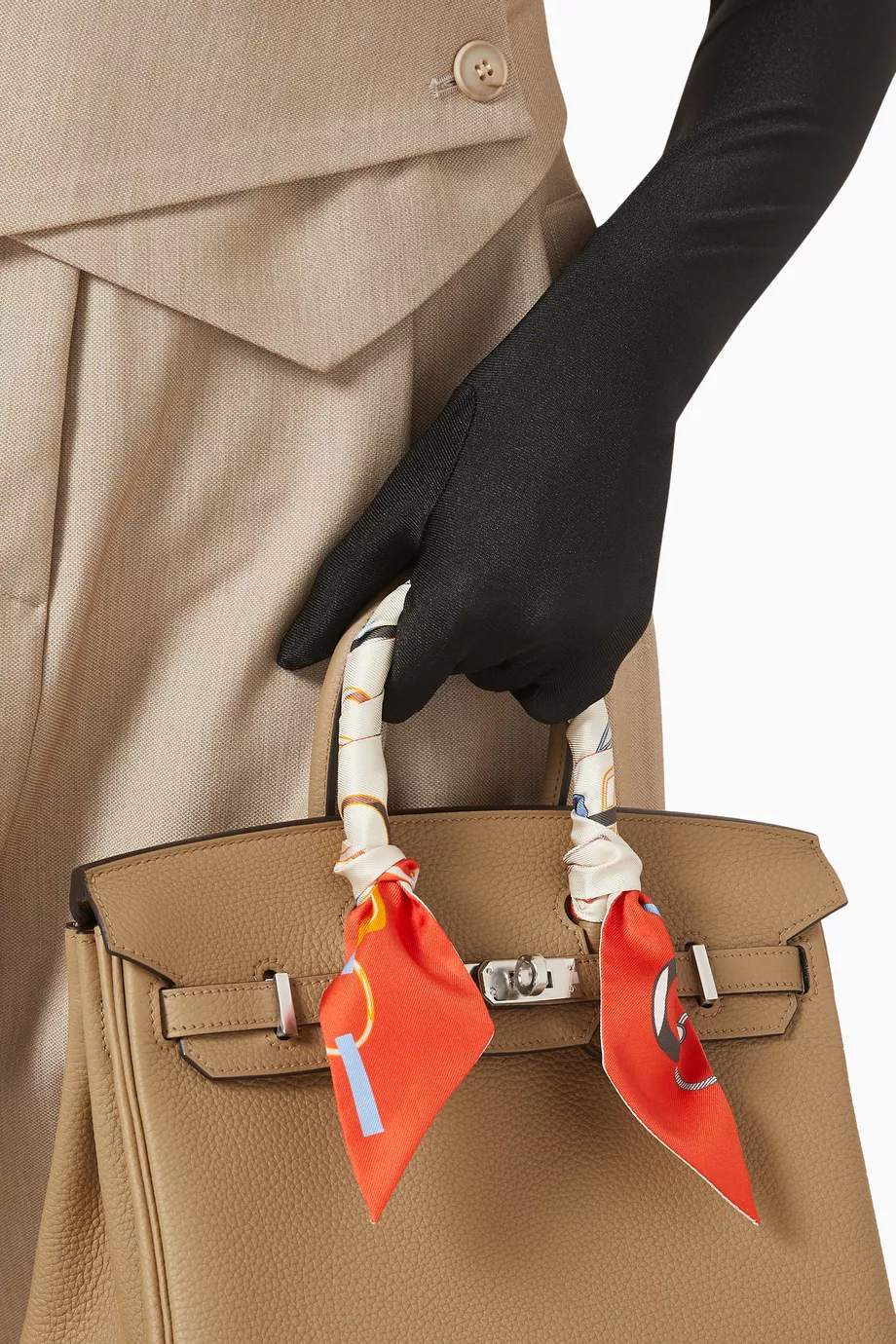
Wrapping a Twilly around a smooth handle can introduce colour and help reduce direct contact from hands. However, the scarf itself will be exposed to friction, pressure and possible colour transfer.
A full Carré 90 tied to a bag creates a more dramatic effect but may hang against clothing, hardware or the ground. It is better reserved for situations where the bag will not be handled roughly.
If you choose bag styling:
- Use a Twilly rather than a full square for handle wrapping.
- Avoid rough, embellished or chain-heavy bags.
- Do not leave the silk permanently tied.
- Check dark leather and denim for colour transfer.
- Retie the scarf periodically to avoid setting deep creases.
- Remove it before travelling or placing the bag beneath a seat.
A scarf intended primarily for bag decoration should be chosen differently from one worn near the face. Strong contrast and small motifs usually remain more visible when the silk is tightly wrapped.
Care and Storage

Hermès recommends avoiding contact with rain, water and other chemicals, storing scarves flat and untied, and using a professional dry cleaner when cleaning is required. (Hermès Scarf Care)
For regular care:
- Apply perfume and cosmetics before putting on the scarf.
- Allow skincare products to dry completely.
- Remove the scarf before eating messy food or entering heavy rain.
- Keep it away from hook-and-loop fasteners and rough jewellery.
- Untie knots after wearing rather than storing them in place.
- Air the scarf briefly before returning it to storage.
- Fold it along different lines occasionally to avoid permanent creasing.
- Store it in a dry location away from direct sunlight.
- Do not place heavy objects on the rolled edges.
- Keep cashmere-and-silk shawls protected from moths.
Hermès states that scarves and other accessories may be examined for repair or refreshing by its craftspeople, although the available treatment will depend on the condition. (Hermès Maintenance and Repair)
Shop the Edit
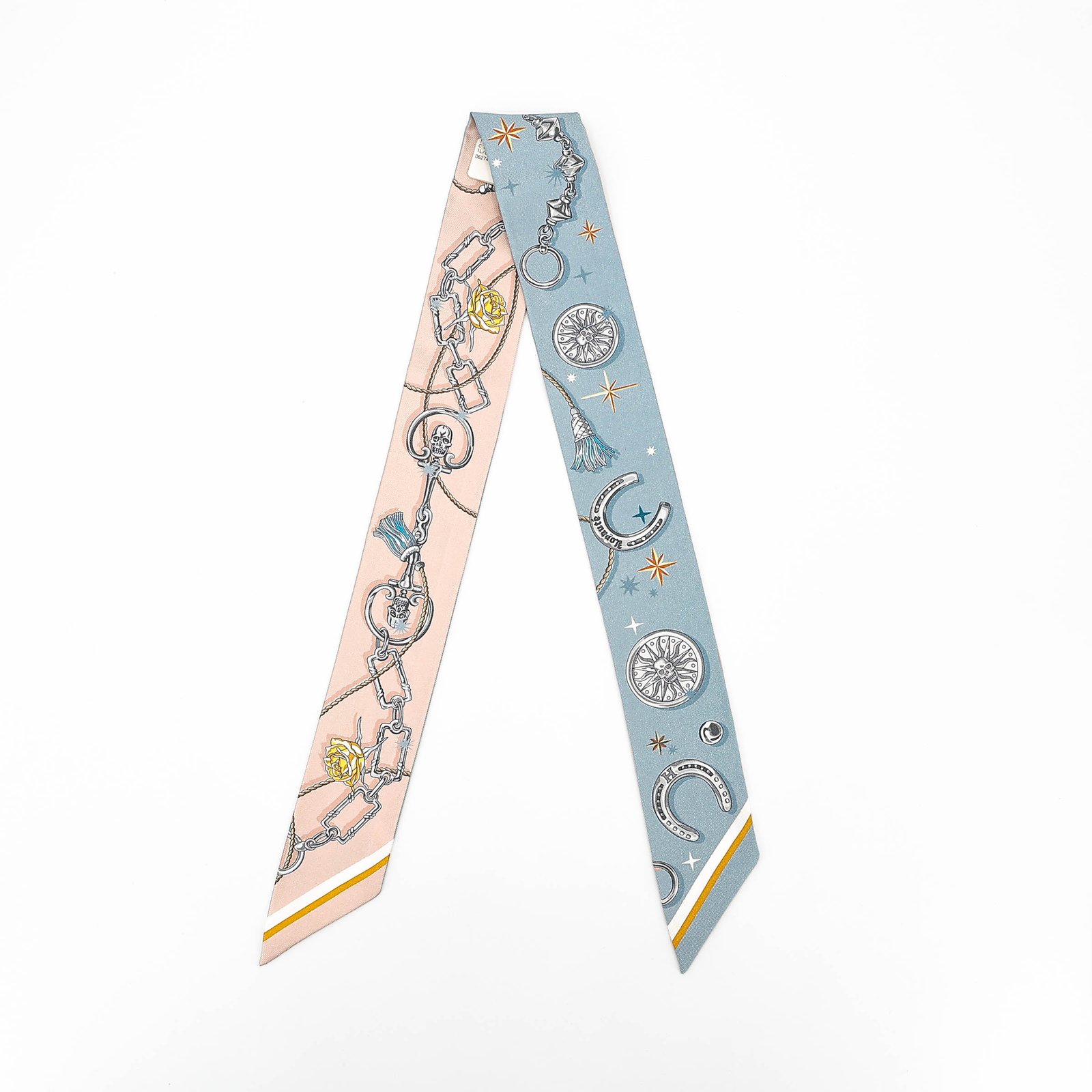
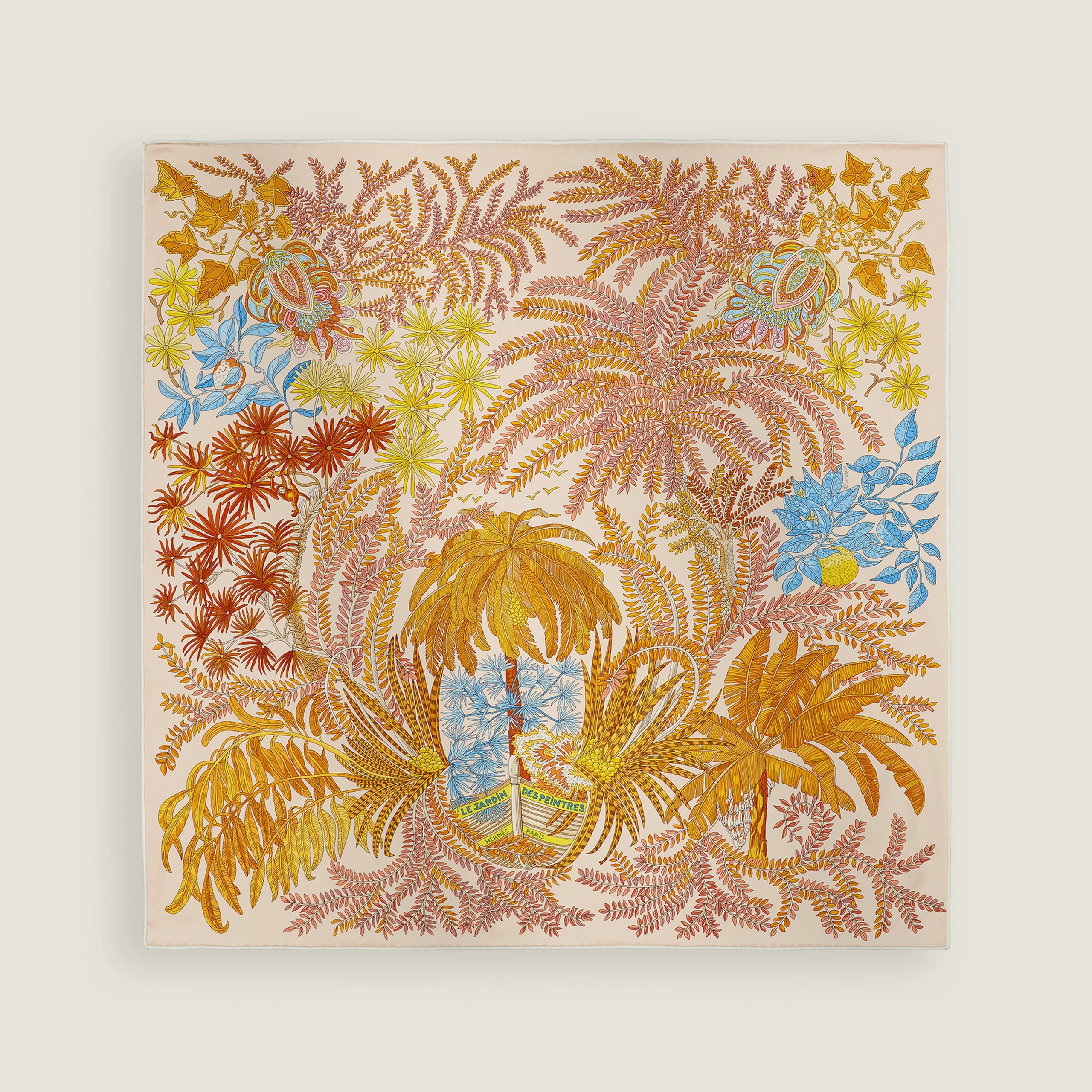
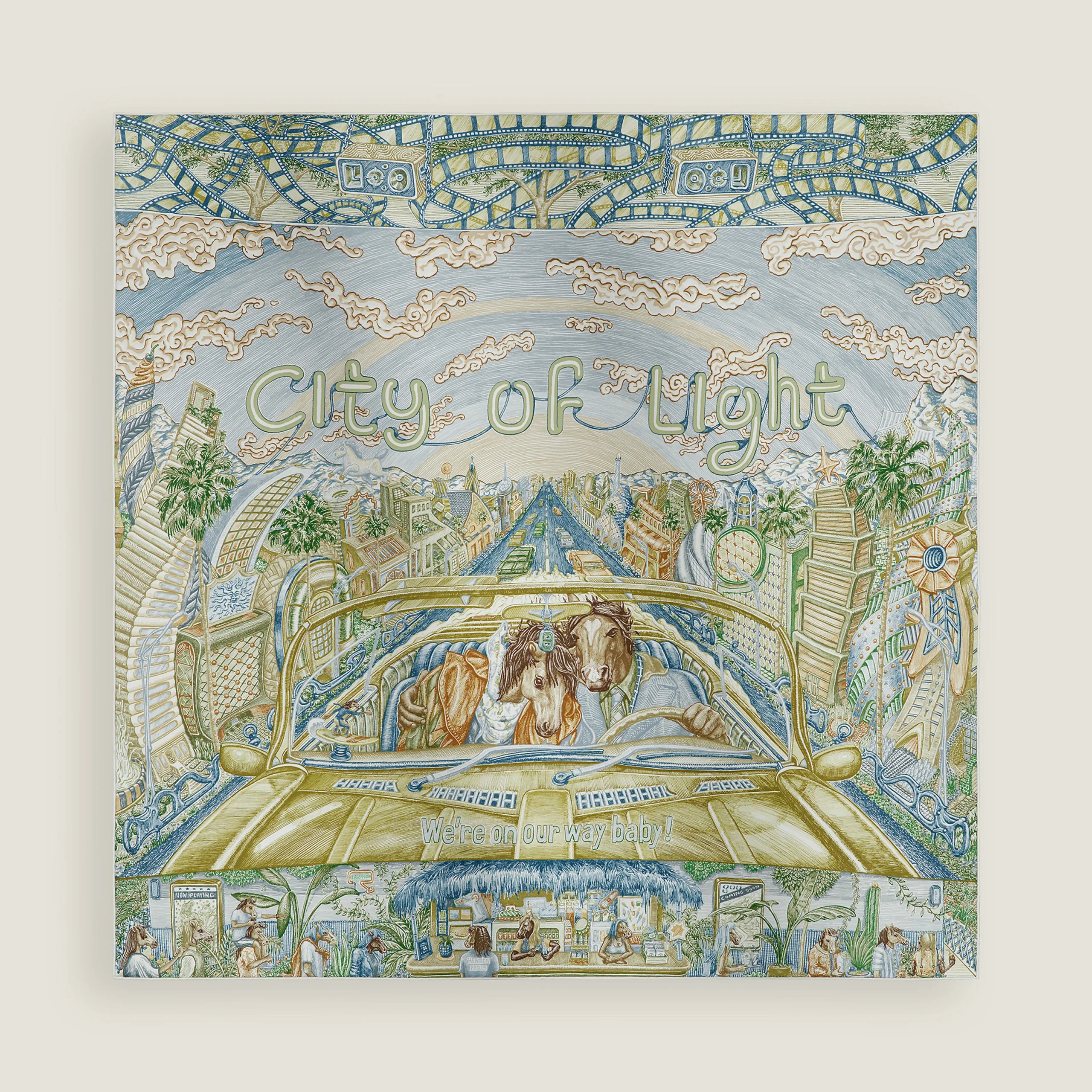
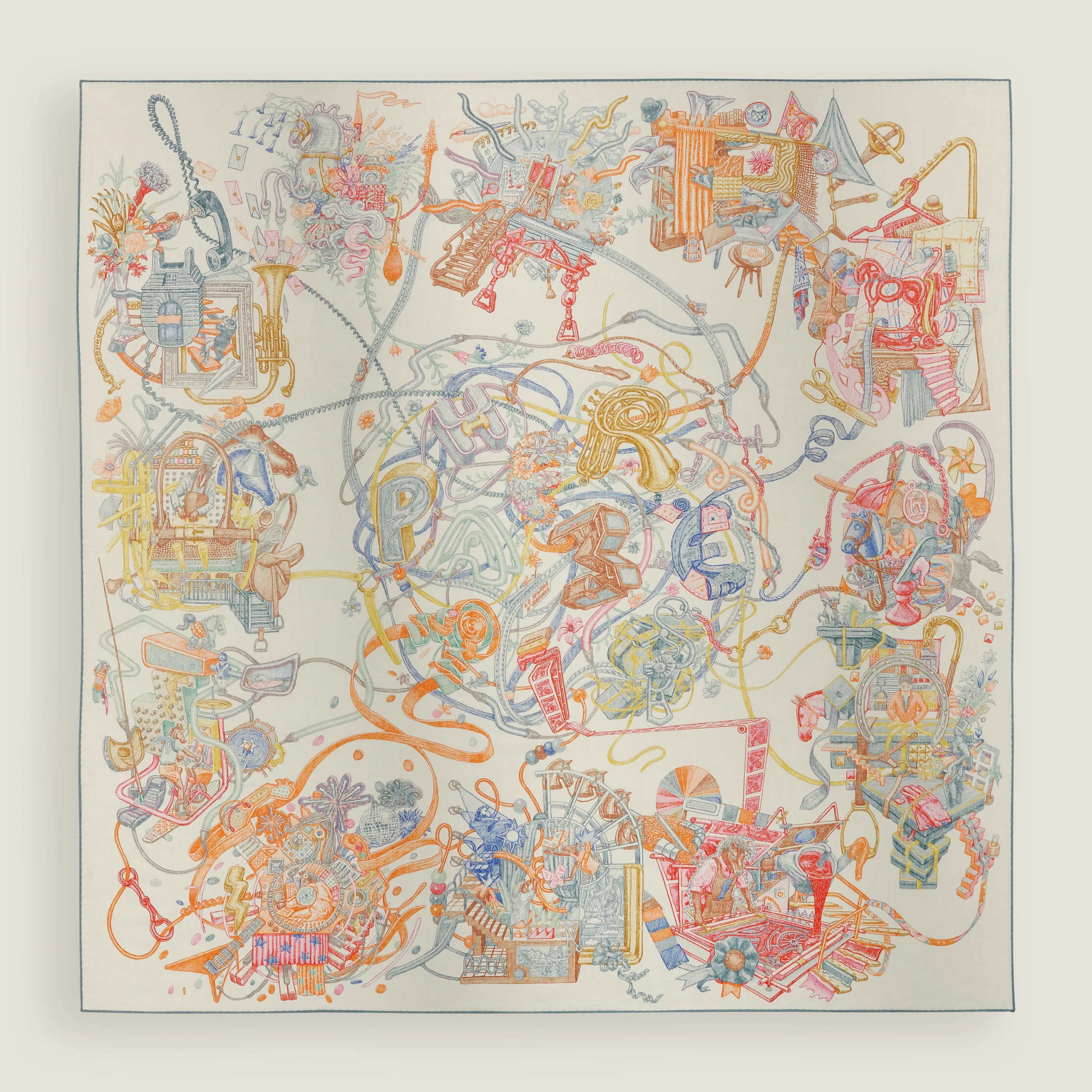
At the time of research, standard US prices were $260 for the C’est la Fête Twilly, $500 for the Le Jardin des Peintres Carré 70, $660 for the City of Light Carré 90 and $1,575 for the Le Monde d’Hermès 140 shawl.
Prices, colourways and availability may change by market.
Pros and Cons
| Pros | Cons |
|---|---|
| Extensive choice of formats, colours and designs | The number of options can make a first purchase overwhelming |
| Carré 90 can be worn around the neck, hair, waist or shoulders | Silk can develop pulls, stains and water marks |
| Hand-rolled edges and detailed printing reward close inspection | Professional cleaning adds maintenance cost |
| Artwork allows the purchase to feel personal | Some colourways are difficult to coordinate |
| Silk twill works across multiple seasons | Complicated knots may discourage frequent wear |
| Twilly offers a lower-priced entry into Hermès silk | A Twilly does not provide the versatility of a full square |
| Cashmere-and-silk shawls provide lightweight warmth | Large shawls require careful storage |
| Heritage designs coexist with contemporary artwork | Popular designs or colourways may become unavailable |
Final Verdict
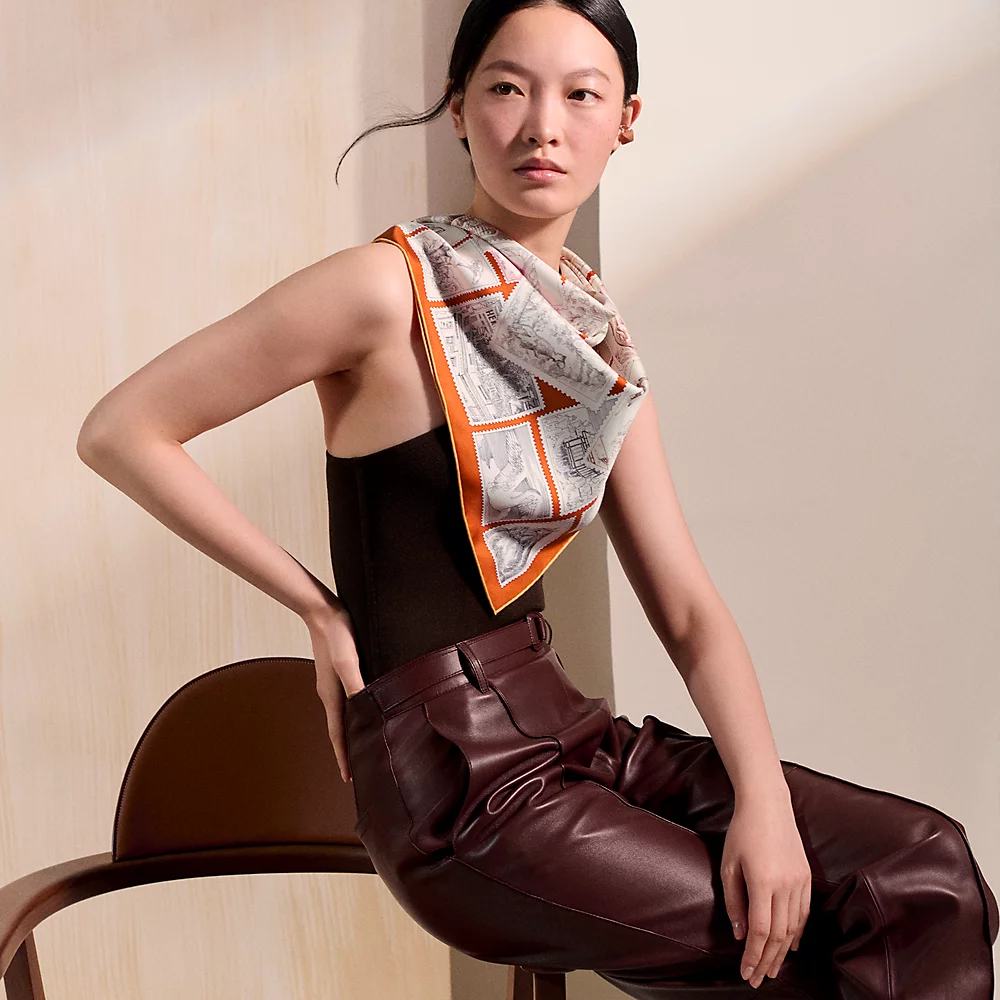
For most buyers, the best first Hermès scarf is a Carré 90 in silk twill.
The format displays the artwork properly while offering enough fabric for neck knots, head styling, shoulder draping and waist accents. It is more representative of the house’s silk tradition than a Twilly and easier to manage than a 140 shawl.
Choose the colourway by looking first at the border and corners, not only the central illustration. Ideally, the scarf should repeat two or three colours already found in your wardrobe. A navy, cream, camel, black or softly multicoloured foundation will generally provide more styling possibilities than an extremely pale or highly seasonal palette.
Select a Carré 70 if you want something lighter and more casual. Choose a Twilly if small accessories suit your personal style, or a cashmere-and-silk 140 if warmth and outerwear styling are the priorities.
Most importantly, do not treat the scarf only as a collectible picture. Fold it, experiment with it and allow the design to change each time it is worn. An Hermès scarf becomes most valuable not when every part of the illustration remains visible, but when its colours and fragments become part of your own wardrobe.
